
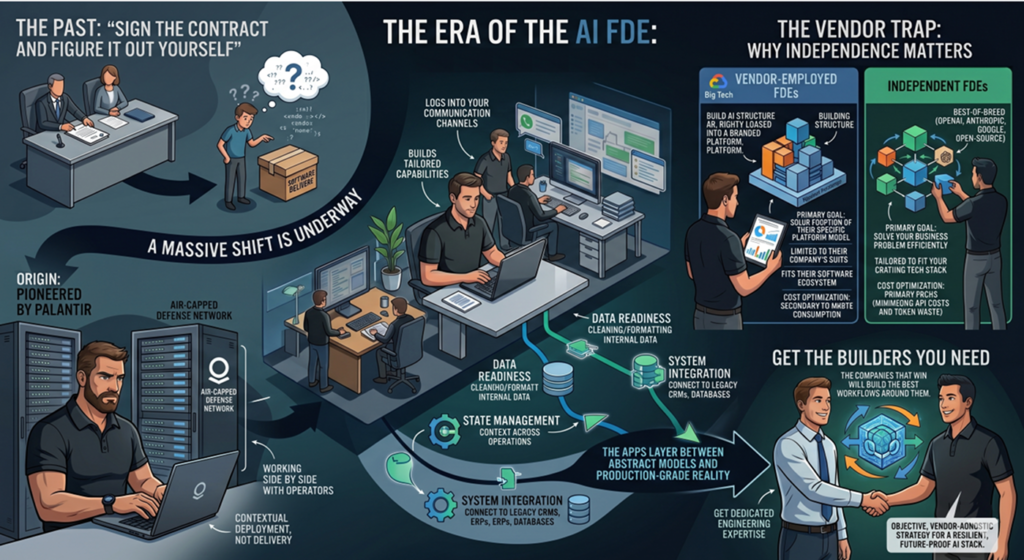
A massive shift is underway in how software is delivered. The era of “sign the contract and figure it out yourself” is over. Instead, a new tech role has taken center stage: the Forward Deployed Engineer (FDE).
Major AI pioneers are racing to build massive FDE teams to get their frontier models working inside big organizations. But what exactly is an FDE, where did this model come from, and why is who you hire as an FDE just as important as the tech they are deploying?
The MindCraft Approach:
Vendor-Independent FDEs
At MindCraft, we believe the FDE model is exactly what enterprises need to unlock the true ROI of AI—but we also believe you shouldn’t have to give up your technical freedom to get it.
MindCraft operates entirely as vendor-independent consultants. When our FDEs embed within your organization to build and tune your agentic workflows, we don’t bring a hidden corporate agenda. Our engineers aren’t tied to a single cloud provider or foundation model ecosystem. Instead, we act purely as your internal engineering advocates, evaluating your infrastructure impartially and choosing the exact combination of technologies that solve your problems most efficiently.
By decoupling the elite engineering talent of the FDE model from the sales targets of big tech vendors, MindCraft gives you on-site execution without sacrificing technical freedom or racking up unnecessary platform costs.
What is a Forward Deployed Engineer
A Forward Deployed Engineer (FDE) is a software engineer who embeds directly within a client’s workflow and organization. Instead of sitting at headquarters building a single generalized feature for millions of users, an FDE logs into your communication channels and builds tailored capabilities specifically for your infrastructure.
In the context of modern enterprise AI, FDEs are the builders who bridge the gap between abstract model capabilities and production-grade reality. They are the ones who write the code, connect internal APIs, prep unstructured data, and tune complex agentic workflows—AI agents that don’t just chat, but actually execute multi-step business processes from start to finish.
Pioneered by Palantir
While trending today, the FDE model was pioneered two decades ago by Palantir to serve defense and government clients on secure, air-gapped networks.
Palantir sent engineers directly to client locations to work side-by-side with operators, building custom pipelines behind secure firewalls. This proved that for highly complex, data-sensitive environments, software must be contextually deployed, not just delivered.
Why the FDE Model is Critical for AI
AI is the new air-gapped network. While enterprise data might live in the cloud rather than a physical bunker, the deployment challenges are identical.
Foundational AI models are highly capable, but they are generalists. They don’t know your specific database schemas, your compliance rules, or the nuanced way your team handles customer workflows. To make AI truly useful, you need someone on the ground to build the “app layer” around the model.
An AI FDE tackles the friction points that prevent AI from reaching enterprise-grade maturity:
- Data Readiness: Cleaning and formatting internal data so an AI agent can retrieve it accurately.
- State Management: Ensuring AI workflows remember context across complex, multi-day operations.
- System Integration: Connecting AI agents directly to your legacy CRMs, ERPs, and internal databases safely.
The Vendor Trap:
Why Independence Changes Everything
Because the FDE model is incredibly effective, big tech vendors and foundation model providers are leaning into it heavily. They will gladly embed their own FDEs into your organization.
However, this comes with a hidden catch: Vendor Lock-In.
An FDE employed by a specific AI giant or platform provider has a primary allegiance to their employer’s ecosystem. They are incentivized to solve every problem using their models, their cloud infrastructure, and their proprietary developer tools—even if a cheaper, faster, or open-source alternative exists.
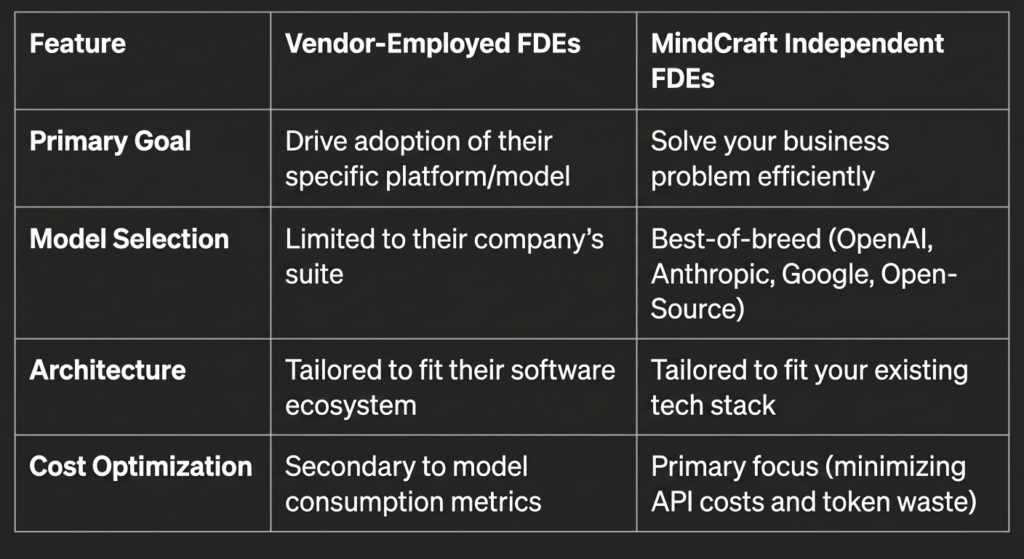
By choosing an independent partner, your embedded engineers are free to mix and match the best tools available. They can use a lightweight, open-source model for basic text routing, a frontier model for complex reasoning, and your own internal infrastructure for maximum security—saving you massive amounts in ongoing operational costs.
Get the Builders You Need
The companies that win the AI race won’t just buy the best models; they will build the best workflows around them. The FDE model is how that happens. With MindCraft, you get the dedicated, on-the-ground engineering expertise pioneered by Palantir, backed by the objective, vendor-agnostic strategy required to build a resilient, future-proof AI stack.
Want to learn more about how our embedded engineers can accelerate your production AI roadmap? Get in touch with the MindCraft team today. Contact us.
you might also like…
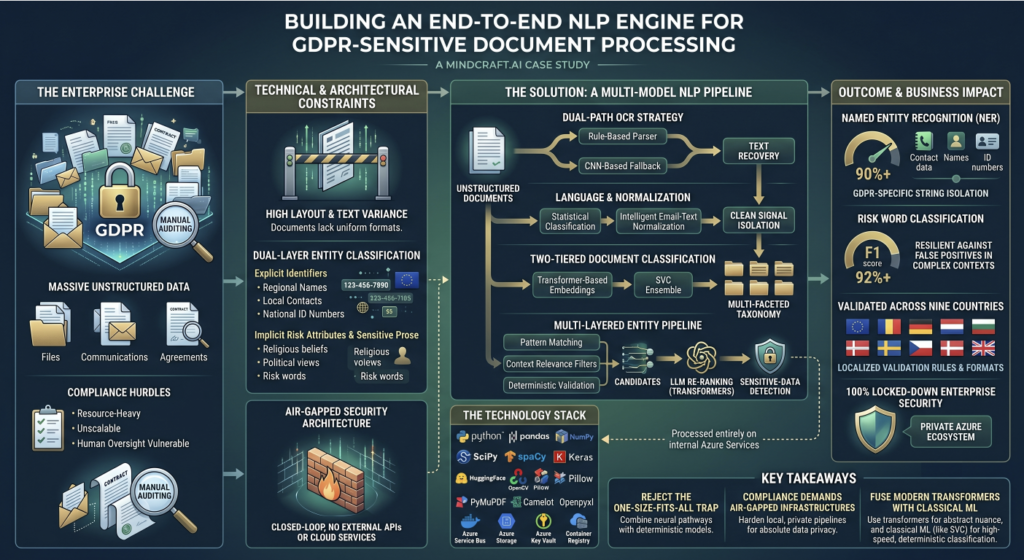
Building a GDPR-Compliant NLP Engine
Case Study: Building an End-to-End NLP Engine for GDPR-Sensitive Document Processing Executive Summary Project Goal: Development of a high-precision, GDPR-compliant... Read more
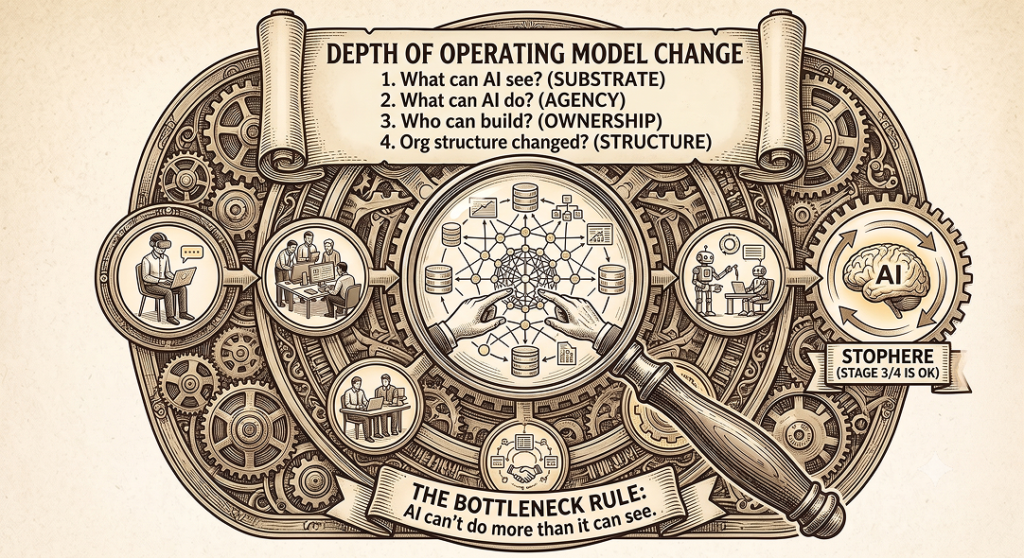
How Deep Does Your AI Transformation Actually Go?
Most companies start using AI and call it a transformation. Here’s a six-stage maturity ladder that measures depth, not usage... Read more